
If you’re thinking about selling your home in Lafayette or Acadiana next year, here’s a question worth answering long before you list:
“What will I actually walk away with?”
Not what your house will sell for. What you’ll net.
Those are two very different numbers. And the months before you list are the best time to close the gap between them, because many of the costs of selling are either negotiable or within your control if you plan ahead.
I’m Jason Ray with Keaty Real Estate. My approach is to work backward from the numbers: start with the result you want, identify the variables, then build the plan.
Here’s how to do that for a 2027 sale.
Sale Price vs. Net Proceeds
Here’s the simple version:
Sale price − mortgage payoff − selling costs − prep and carrying costs = what you walk away with
Every piece of that equation can move. Some you control now. Some get negotiated later. And some don’t show up until you’re under contract.
The Costs Lafayette Sellers Should Plan For
- Brokerage compensation
For most sellers, this is one of the larger expenses.
There is no universal or government-set commission rate. Brokerage compensation is negotiable and is set by the agreements in your transaction. So when an online calculator subtracts a fixed percentage, treat it as a rough guess, not your number.
- Mortgage and lien payoffs
Paying off your mortgage isn’t really a “cost” of selling. You’re settling debt that’s already tied to the house. But it’s usually the biggest number between your sale price and your check.
Your payoff can differ from your last statement because of interest through the closing date. Second mortgages, home equity lines, and other liens are paid at closing too.
- Property-tax prorations
Your closing statement will divide the year’s property taxes between you and the buyer based on the closing date. In Louisiana, property taxes are generally billed toward the end of the year, so sellers commonly credit the buyer for their share at closing.
- Buyer concessions
In today’s market, buyers often ask for help with closing costs or a mortgage-rate buydown. That’s negotiable, and it’s one of the biggest swing items on your net sheet.
- Inspection repairs or credits
Most Louisiana home inspections turn up something: roof, HVAC, plumbing, electrical, water intrusion or wood damage. The buyer may ask for repairs, a credit or a price adjustment.
And remember: a buyer asking for $8,000 doesn’t mean the problem costs $8,000 to fix. Knowing what’s actually wrong and what it reasonably costs is a big part of negotiating well.
- Title and curative issues
Occasionally something has to be fixed before the property can transfer: an old mortgage that was never released, a judgment, a succession issue or a documentation problem. Not every seller runs into these, but when they show up, they cost time and money. Finding them early is better.
- Preparation
Paint, landscaping, pressure washing, cleaning, minor repairs and HVAC servicing can all help your home show better.
The goal isn’t to renovate everything. It’s to spend where the money has the biggest impact. A $750 fix that changes how buyers see the house may make sense. A $15,000 project that adds $5,000 in value probably doesn’t.
- Carrying costs (time)
Every month your home is on the market, you’re still paying the mortgage, insurance, utilities, upkeep, and taxes.
In September 2026, Lafayette-area homes averaged 72 days on the market, about 18% longer than a year earlier. An overpriced home can sit much longer. Sometimes the highest cost of selling isn’t a fee at all. It’s chasing the market down with a price that started too high.
A Louisiana Difference: No Transfer Tax
If you’re using an online calculator, be careful.
Louisiana does not have a real estate transfer tax. Many other states charge sellers a tax when a property changes hands, and national calculators often build that in.
That means a calculator designed for another state can overstate what it costs to sell here. Normal recording fees and property taxes still apply. Real estate costs are local.
Which Offer Nets You More?
Here’s an example of why the number at the top of the contract isn’t the whole story.
Offer A: $290,000, buyer pays their own closing costs, inspection repairs capped at $1,500.
Offer B: $296,000, seller pays $7,500 toward buyer closing costs, no repair cap.
Offer B looks $6,000 better. But after the $7,500 concession, it’s already $1,500 behind Offer A, before any repair requests.
That doesn’t make Offer A automatically better. Financing, appraisal risk, inspection terms, timing, and the odds of closing all matter too.
But it’s why I tell sellers: don’t judge an offer by the price at the top. Judge it by what you keep.
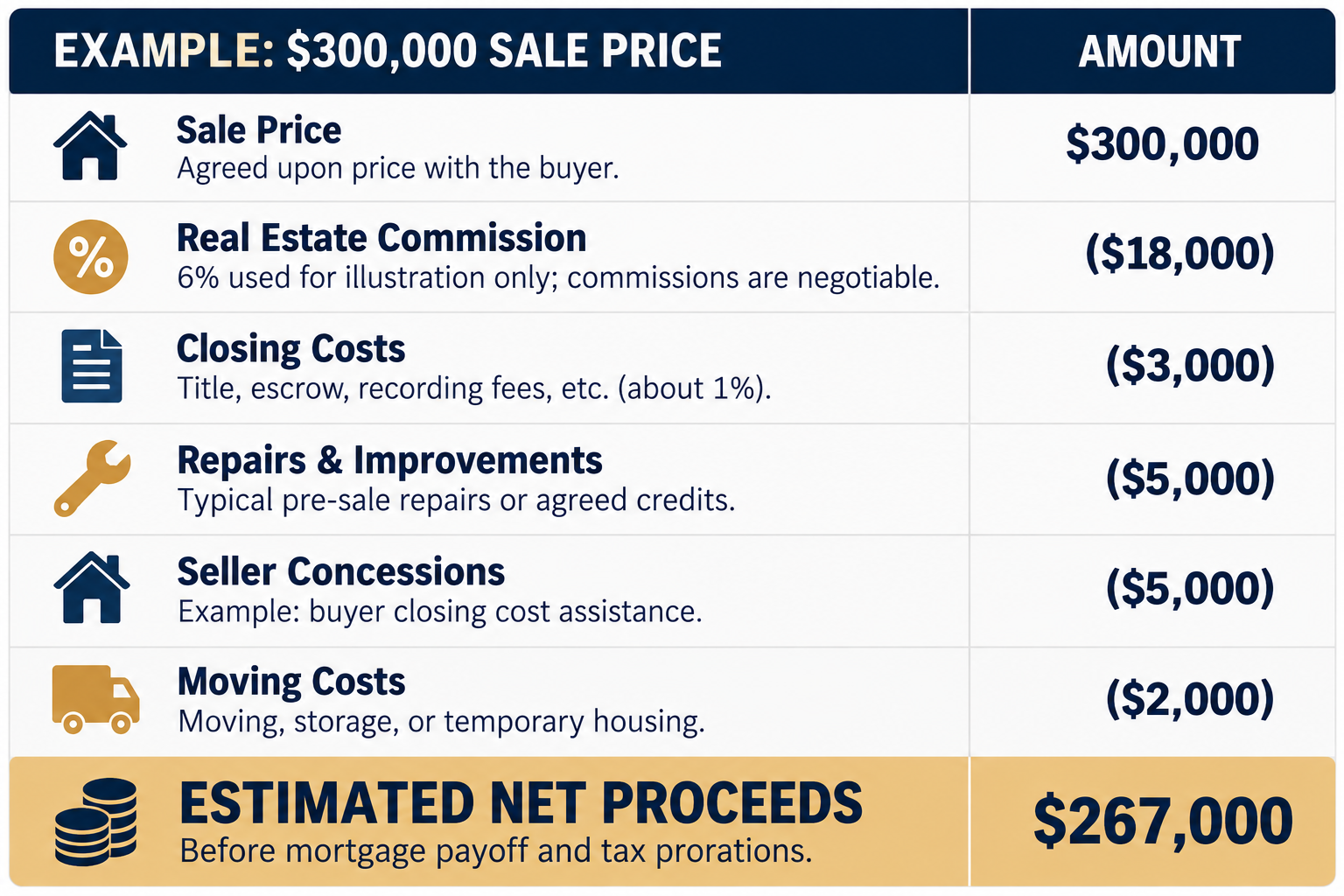
What a Sample Net Sheet Looks Like
In my October market update, the average Lafayette-area sale price for September 2026 was $295,992. Let’s use that for an example.
Sale price: $295,992
Brokerage compensation (6% for illustration only): −$17,760
Seller closing expenses (illustration): −$1,000
Repairs and preparation (illustration): −$3,000
Estimated proceeds before payoff and prorations: about $274,232
Mortgage payoff, tax prorations and concessions: property-specific
The 6% is used only to show the math. It is not a standard, required or recommended rate. Brokerage compensation is negotiable and depends on the agreements in each transaction.
Change the brokerage agreement and that number changes. Add a buyer concession and it changes again. That’s exactly why a personalized net sheet beats any rule of thumb.
Your 2027 Seller Cost Timeline
Here’s when each cost is worth tackling if you’re planning to sell next year:
Now (3–6 months out)
• Get a realistic value and a written net estimate
• Request a mortgage payoff estimate
• Look for possible title issues early
60–90 days out
• Decide which repairs and updates are worth it
• Service the HVAC and handle known safety items
• Get bids so you know real costs, not guesses
When you list
• Price it right from day one to limit carrying costs
• Decide ahead of time how much flexibility you have on concessions
Under contract
• Weigh repair requests against real costs and the risk of losing the buyer
• Review the closing statement against your net estimate
Frequently Asked Questions
How much does it cost to sell a house in Lafayette, LA?
It depends on your brokerage agreement, mortgage payoff, property-tax proration, concessions, repairs, title issues, and the terms you negotiate. The most accurate answer is a personalized seller net estimate.
Is there a real estate transfer tax in Louisiana?
No. Louisiana does not have a real estate transfer tax. Normal recording fees and property taxes still apply.
Are real estate commissions negotiable in Louisiana?
Yes. There is no government-set commission rate. Brokerage compensation is set by the agreements in your transaction.
Can a buyer ask me to pay closing costs?
Yes. Seller concessions toward allowable buyer costs are common in today’s market. Whether to agree depends on the entire offer, not just the request.
When should I start planning to sell in 2027?
Three to six months before you list is a good starting point. That gives you time to estimate your net, make smart repairs, and choose your timing.
The Bottom Line
Don’t just ask, “What can I sell my house for?”
Ask, “What am I likely to walk away with?”
If you’re thinking about selling in 2027, I can prepare an estimated value and seller net analysis before you make any decisions. You don’t have to list your home just to find out what selling might look like.
Request your free home value report: https://jray.keatyrealestate.com/home-valuation/
Jason Ray Realtor | Keaty Real Estate
Engineering Better Real Estate Decisions
Cell: 337-230-0664 | Office: 337-247-9415